HAIC Horizon
EVERY HKUST GRADUATE,
READY FOR THE AGE OF AI
A new Common Core commitment: six dedicated credits of AI and data literacy for every undergraduate, beginning in 2026–27
All HKUST undergraduate students admitted from 2026-27 onward will complete six dedicated credits developing the AI and data literacy they need to learn, work, and lead in a world transformed by artificial intelligence. This commitment makes HKUST one of the first universities in the region to guarantee that all students, regardless of major, are able to use AI thoughtfully, work alongside intelligent systems, and judge AI's impact on society.
|
Why this matters for every student |
AI is changing what is expected of graduates in every field, not only in science and technology, but also in business, healthcare, education, public service, and the creative industries. As AI becomes embedded in everyday life and professional practice, all students need a foundational understanding of how AI systems work, what they can and cannot do, and how to engage with them responsibly. The Human-AI Co-Creation and Data Literacy (HAIC) requirement ensures that every HKUST graduate develops the knowledge, skills, and perspectives needed to use AI thoughtfully, evaluate its implications critically, and contribute to a future where technology serves human and societal needs. It also builds genuine data literacy, the ability to read, question, and reason with the data that AI systems depend on, so that students can judge the evidence behind any AI-assisted decision. |
|
What Students Will Learn |
The HAIC curriculum is built around three connected learning outcomes, approved by the University Senate. Together they give students the knowledge, skills, and judgment to understand AI and the data behind it, collaborate effectively with AI systems, and critically evaluate AI's wider impact on individuals, organizations, and society. Every HAIC course advances one or more of these outcomes, so that students build a well-rounded foundation for engaging with AI confidently, responsibly, and effectively. |
| THREE LEARNING OUTCOMES | ||||||||||||||
|---|---|---|---|---|---|---|---|---|---|---|---|---|---|---|
|
|
|
||||||||||||
| FOUR DIMENSIONS OF AI COMPETENCY | |
|---|---|
|
While the three Area Intended Learning Outcomes articulate the core capabilities that all students should develop, achieving these outcomes requires learning experiences that span multiple forms of knowledge and practice. To provide a comprehensive baseline of AI fluency, the HAIC curriculum is structured around four dimensions of AI competency. Together, these dimensions help students understand AI within disciplinary contexts, work effectively with AI systems, develop technical understanding where appropriate, and cultivate the critical thinking and adaptability needed to navigate an AI-enabled future. |
|
|
Domain / Disciplinary Knowledge |
Understanding how AI transforms the concepts, methods, and knowledge structures of a specific discipline. This includes knowing what AI can and cannot do within a field, how AI-generated outputs relate to that discipline's standards of evidence, and how AI is reshaping professional practice. Courses with this dimension help students see AI through their disciplinary lens—not as a generic tool, but as something that changes what counts as knowledge in their field. |
|
Procedural Knowledge |
Knowing how to work with AI effectively—the practical techniques, workflows, and collaboration patterns for human–AI interaction. This includes prompt engineering, workflow design, delegation strategies, validation routines, and iterative refinement. Procedural knowledge answers the core question: How do I actually use AI to accomplish a goal? |
|
Technical Skills |
Understanding the underlying mechanisms of AI systems—how models are trained, how data shapes outputs, what architectures enable different capabilities, and how to evaluate system performance. Technical skills range from conceptual understanding (such as the difference between supervised and reinforcement learning) to hands-on competency (such as building a Retrieval-Augmented Generation chatbot or fine-tuning a model). |
|
Cognitive and Employability Skills |
Higher-order thinking abilities developed through working with AI—critical evaluation of AI outputs, metacognitive awareness, ethical reasoning, systems thinking, and the capacity to adapt as AI evolves. These are transferable skills that prepare students for a workforce where AI is embedded in every role, regardless of discipline. |
| HOW THE REQUIREMENT WORKS | ||||||
|---|---|---|---|---|---|---|
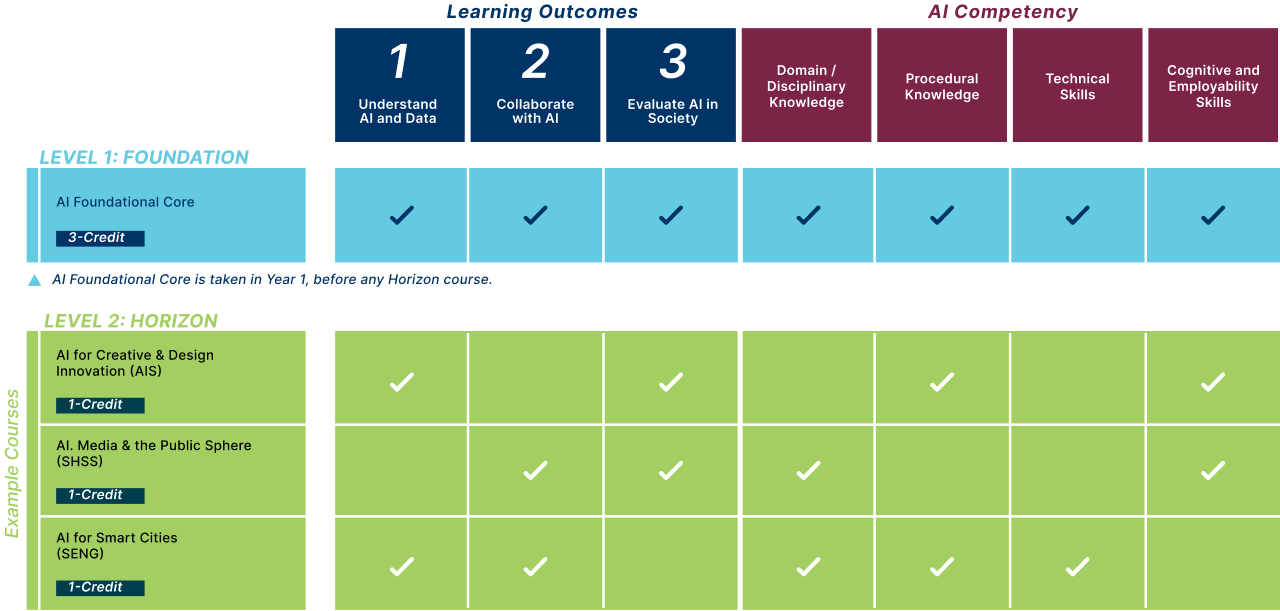
| All undergraduate students admitted from 2026–27 onward complete 6 credits within the HAIC area. The curriculum is organized in two levels, pairing a common foundation for all students with opportunities for disciplinary and interdisciplinary exploration. | ||||||
|
FOUNDATION COURSE Students begin with a foundational learning experience introducing core ideas in artificial intelligence, data literacy, human–AI collaboration, and the societal implications of AI. This shared foundation ensures that every student develops a common baseline of knowledge, skills, and perspective for engaging effectively and responsibly with AI. It is completed in Year 1 and serves as the prerequisite for higher-level HAIC courses. |
|||||
|
HORIZON DISCIPLINARY-BASED COURSES Building on this foundation, students complete a further 3 credits through a wide range of domain-specific HAIC courses offered by Schools across the University. These courses let students explore how AI is transforming different disciplines, professions, and areas of inquiry, while deepening their grasp of the HAIC learning outcomes and competency dimensions. |
|||||
|
||||||
|
Domain-Specific Course Catalog >
|
||||||
|
Together, the Foundation and Horizon levels prepare graduates to understand AI and the data behind it, collaborate effectively with intelligent systems, and critically evaluate AI across diverse contexts. | |||||


| WHAT A HAIC PATHWAY CAN LOOK LIKE |
|---|
|
The Level 1 Foundation course in Year 1 introduces all three learning outcomes and all four competency dimensions, while each Horizon course chosen from different Schools reinforces a specific combination. This is one of many possible combinations: |